Showing posts with label Plaka. Show all posts
Thursday, May 14, 2015
Monday, April 13, 2015
Hangin' in the Plaka
What do you do in the Plaka?
![]() |
| You shop at the new Hard Rock Cafe shop... |
![]() |
| you check out the local church... |
![]() |
| you watch your step... |
![]() |
| you overhear tourists wondering if the lamb is dog... |
![]() |
| (it's not.) |
![]() |
| you buy wonderful jewelry made in Greece... |
![]() |
| try to read the signs... (it says, "Easter in Athens") |
![]() |
| and you take loads of photos! |
The Sun is Shining!
The last half of Spring Break turned out to be absolutely lovely. The sun shone bright in a vivid blue sky while a slight breeze kept everything comfortable (and the Greeks a little chilly!). We loved it...even Mr. Foltz took off his sweater!
We meandered over towards the edge of the Plaka where you can get a good view of the Acropolis. I was intent on getting a photo of the exact spot in that painting we saw a few days ago in that cool gallery.
![]() |
| Chuck is scoping out exactly the location and angle while we wait for our coffees |
![]() |
| sitting right beside the Ancient Roman Agora |
![]() |
| now, here's a handsome man! |
![]() |
| the view from the other side of the Agora...we were sitting under those umbrellas you can see |
![]() |
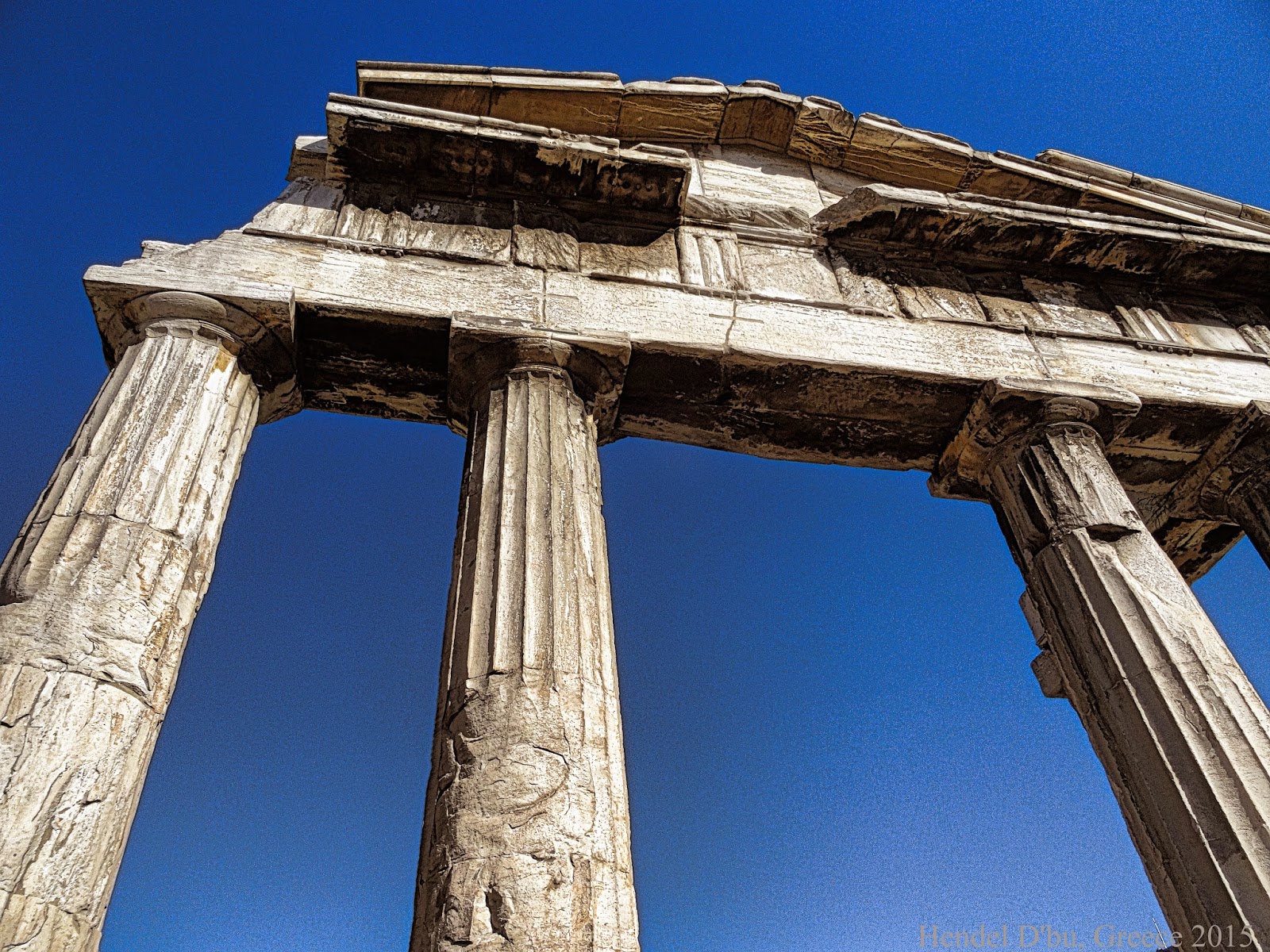
| this is remains of the ancient Roman Library |
![]() |
| Here it is - my shot! And, here is the painting, just for comparison... |
![]() |
| cool, huh? |
Sunday, April 12, 2015
Who are these people, anyway?
The Romani people of Greece are called Arlije/Erlides, Tsiganoi or the more derogatory term Gyftoi (Gypsies). The number of Roma in Greece is currently estimated to be between 200,000 and 300,000 people.
The history of Roma in Greece goes back to the 15th century. The name Gypsy sometimes used for the Romani people was first given to them by the Greeks, who supposed them to be Egyptian in origin. Due to their nomadic nature, they are not concentrated in a specific geographical area, but are dispersed all over the country. The majority of the Greek Roma are Orthodox Christians who speak the Romani language in addition to Greek. Most of the Roma who live in Western Thrace are Muslims and speak a dialect of the same language.[1]
The Roma in Greece live scattered on the whole territory of the country, mainly in the suburbs. Notable centres of Romani life in Greece are Agia Varvara which has a very successful Romani community and Ano Liosia where conditions are less well. However, between 1998-2002, 502 Albanian Roma children disappeared from the Greek Foundation for children Agia Varvara. These cases were not investigated by the Greek authorities until the European Union forced an investigation, which only led to the recovering of 4 children. The children who were sold by the state were presumably sold to human traffickers for sexual slavery or organ harvesting, according to a report submitted by the Greek government to the European Commission.
Roma largely maintain their own customs and traditions. Although a large number of Roma has adopted a sedentary and urban way of living, there are still settlements in some areas. The nomads at the settlements often differentiate themselves from the rest of the population. They number 200,000 according to the Greek government. According to the National Commission for Human Rights that number is closer to 250,000 and according to the Greek Helsinki Watch group to 300,000. As a result of neglect by the state, among other factors, the Romani communities in Greece face several problems including high instances of child labour and abuse, low school attendance, police discrimination and drug trafficking. The most serious issue is the housing problem since many Roma in Greece still live in tents, on properties they do not own, making them subject to eviction. In the past decade these issues have received wider attention and some state funding. On two occasions, the European Committee of Social Rights found Greece to violate the European Social Charter by its policy towards Roma in the field of housing.
The majority of the Greek Roma are Orthodox Christian and have taken a Greek identity (language, names) while a small part of them, the Muslim Roma, (may be) concentrated in Thrace. ~wiki
ATHENS, Mar 24 - Two women sit on a bench outside an Orthodox Church, their children running around them, in the Agi Varvara neighbourhood of Piraeus, close to the Greek capital. The women are Greek Gypsy, or Roma. They are in all likelihood illiterate and likely to remain that way for the rest of their lives. What this means is that should their children beat the odds and enter the school system, the mothers will be unable to help with the homework. Agia Varvara is the most affluent Gypsy community in Greece, yet not one Gypsy woman here is on record as having completed secondary school. ~source
Above is a group of Gypsy women that I recognize, as they approach me every time I am in this area of the Plaka. They approach and grandly offer a rose proclaiming it to be "free" - which is totally not the case. If a person takes the offered flower, they then insist you pay them, usually a euro. They are very insistent and you have to be downright rude to get them to stop pestering you. Some of them, upon refusal, will say something under their breath in a foreign tongue (which I always equate to a curse or insult of some sort).
The older women trade in their roses for tablecloths. Holding it out for you to examine and touch, they call you from several steps away, trying to attract your attention. They are also insistent, and it takes some ignoring to make them stop following you. Who in the world needs a tablecloth when they are traveling? They are trying to sell these for 5 euros - at least they are not saying they are free.
The children are the worst for me, though. They are as young as 5 on up, they 'play' the accordion and sometimes sing. It is not unusual for a young child to be outright begging - with no parent or older sibling in sight. They are very insistent, and will mock you to your face for refusal, or treat you to the curse/insult business. I have never gotten a good feel from any of them.
Lastly are the men. They are the least offensive offering selfie-sticks, umbrellas (if it is raining), or flowers. At least they take no for an answer.
I feel bad for these people. The tourists have no idea of the situation, only that they are highly irritating and difficult to deal with. Along with them, there are many street beggars and disabled needy who are also asking for a hand-out. It is difficult for a non-Athenian to know what to do. If you did want to give, you could be out a lot of cash in a hurry giving to all the needy just along Ermou Street. There have been some incidents of attacks of tourists by these Roma, as well as pick-pockets, but it is rare. The smart traveler is aware of their surroundings at all times, and doesn't make themselves a target due to distraction.
I have picked out a couple of needy who are my favorites that we regularly give to. We also have supported the local street vendors and small business owners, purchasing from them instead of mass-produced souvenir shops. At least they have hand-crafted items and they are not in-your-face insistent. The bottom line for me is that I use my intuition about someone asking for money, and give (or not) accordingly.
Friday, April 10, 2015
Friday Walk-About - Spring Break Edition
We had planned on checking out a museum or two today on our last weekday of Spring Break, but no luck - they were all closed for Easter, apparently. So we had a nice walk about in the sunshine. Don't be fooled, though...there was snow in the mountains and a bitter cold wind was whipping through Athens this morning.
![]() |
| we discovered this interesting statue of sorts by the National Art Gallery |
![]() |
| and this most interesting modern art by the plethora of embassies near Kolonaki (oh, and we found the TGI Fridays!) |
![]() |
| we sat and enjoyed the scenery and sunshine in the Thissio neighborhood - Chuck snapped a few pics |
After a brief conversation with an older gentleman who wanted to tell us that he remembered the time when it was free to get onto the Acropolis, we decided to walk some more. It was getting warmer, so we headed back into the Plaka, and sat in the sun enjoying cocktails. Finally giving up our table, we ventured into some clothing stores despite the cling-on sales people and found a couple of fun additions to my limited wardrobe. Then we made our way into a wonderful art gallery and found this:
![]() |
| a wonderful painting of the Plaka neighborhood right off the ancient Roman Agora; the church is one we have visited several times |
![]() |
| now, THIS is good, authentic Greek food! |
![]() |
| this was the view from the second floor of our restaurant - the bells were ringing... |
![]() |
| and people were coming and gathering - a lot of them, and they just kept coming! |
Monday, April 6, 2015
Watchin' Our Step!
![]() |
| Caution! Slippery when wet! |
Athens must be famous somewhere for its...um...interesting sidewalks! People walk absolutely everywhere (either that, or ride public transport), and it is amazing that more people don't get hurt on these sidewalks. Don't believe me? Take a look for yourself...
![]() |
| straight down shot - this is grooved tiles to funnel rainwater |
![]() |
| this scaffolding is to prevent the falling down building from falling on someone's head! |
![]() |
| there was a bit of a back up in the Plaka - wow! |
![]() |
| yes - a lot of sidewalks are this skinny! |
![]() |
| oops! careful where you walk! |
Subscribe to:
Posts (Atom)